The public claim is intentionally below the internal ambition. Controls, reporting, and repeatability must earn escalation.
Private review / paper validation
AI-native capital system for machine-scale markets.
Governed autonomous capital allocation for fragmented, machine-speed markets. Cygnus X-1 is being built as a crypto first hedge fund architecture where market ontology, specialist agents, risk veto, execution controls, and continuous learning operate as one auditable investment loop.
- What it is
A fund architecture, not an AI wrapper: agents participate in research, strategy generation, risk review, execution, attribution, and learning.
- Why it matters
Markets are increasingly machine scale. The edge shifts toward systems that can infer state, route decisions, refuse bad trades, and preserve richer operating memory.
- Investor path
Public thesis first. Qualified diligence second. Live capital only after controls, reporting, and paper validation deserve review.
Fragmented, reflexive, always-on markets provide a dense proving ground for ontology, execution, and risk logic.
The fund creates the stress history, execution memory, and governance evidence required before platform claims matter.
Allocator-facing materials are sequenced: public thesis, controlled review, then private operating detail.
Investment thesis
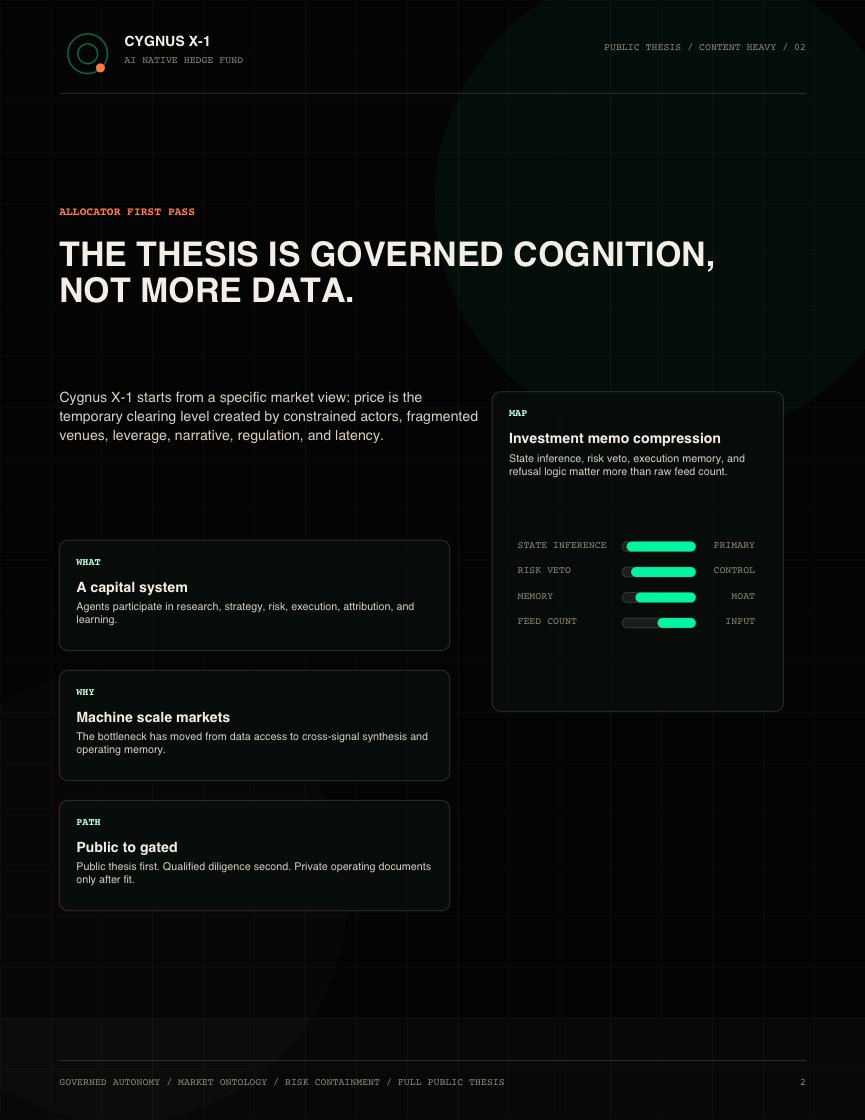
The thesis is governed cognition, not more data.
Cygnus X-1 starts from a specific view of markets: price is the temporary clearing level created by constrained participants, fragmented venues, leverage, latency, regulation, and narrative pressure. The investment problem is therefore not simply prediction. It is state inference under constraint.
An AI-native capital system for machine-scale markets should not merely summarize research or accelerate analysts. It should become the native decision architecture for signal ingestion, hypothesis generation, strategy testing, risk veto, execution routing, attribution, and continuous learning.
Allocator first-pass
Market premise
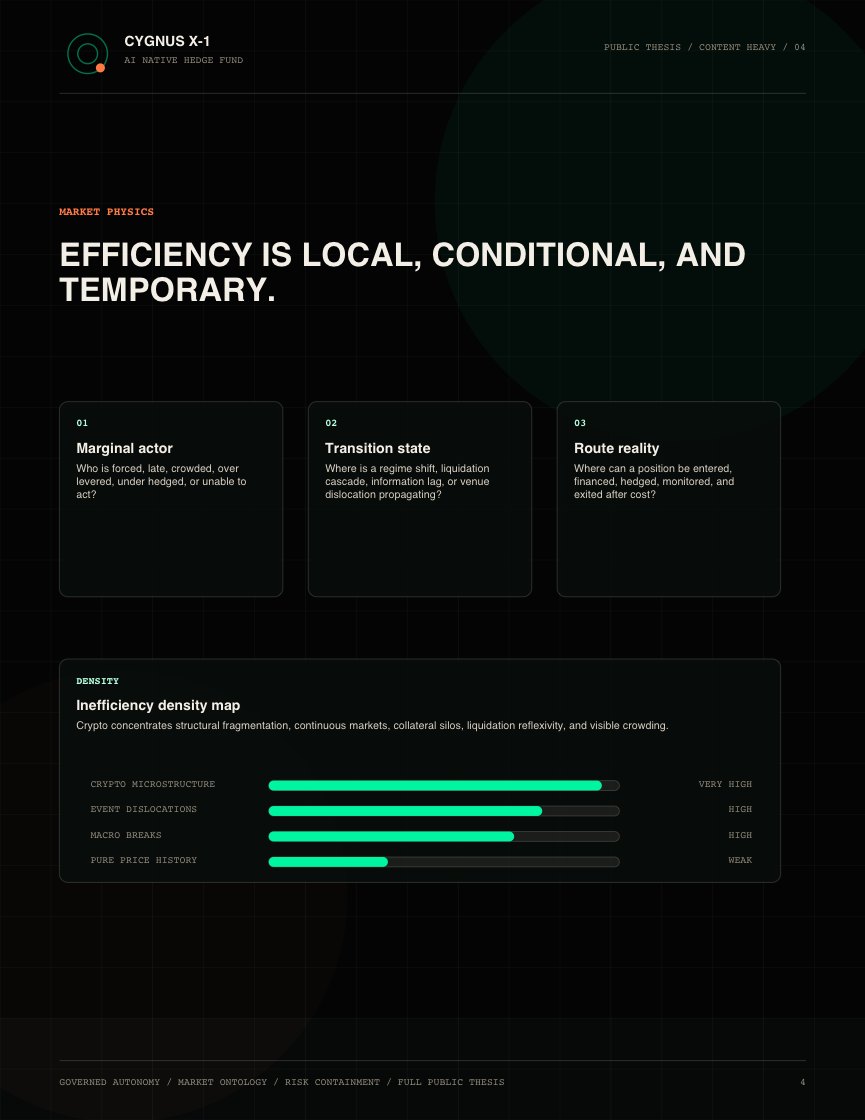
Efficiency is local, conditional, and temporary. It breaks around forced flows, fragmented settlement, crowding, leverage, and regime transitions.
Technology shift
Agentic AI changes the operating bandwidth of a fund: more experiments, faster synthesis, more precise memory, and fewer human bottlenecks inside the research-to-execution loop.
Architecture claim
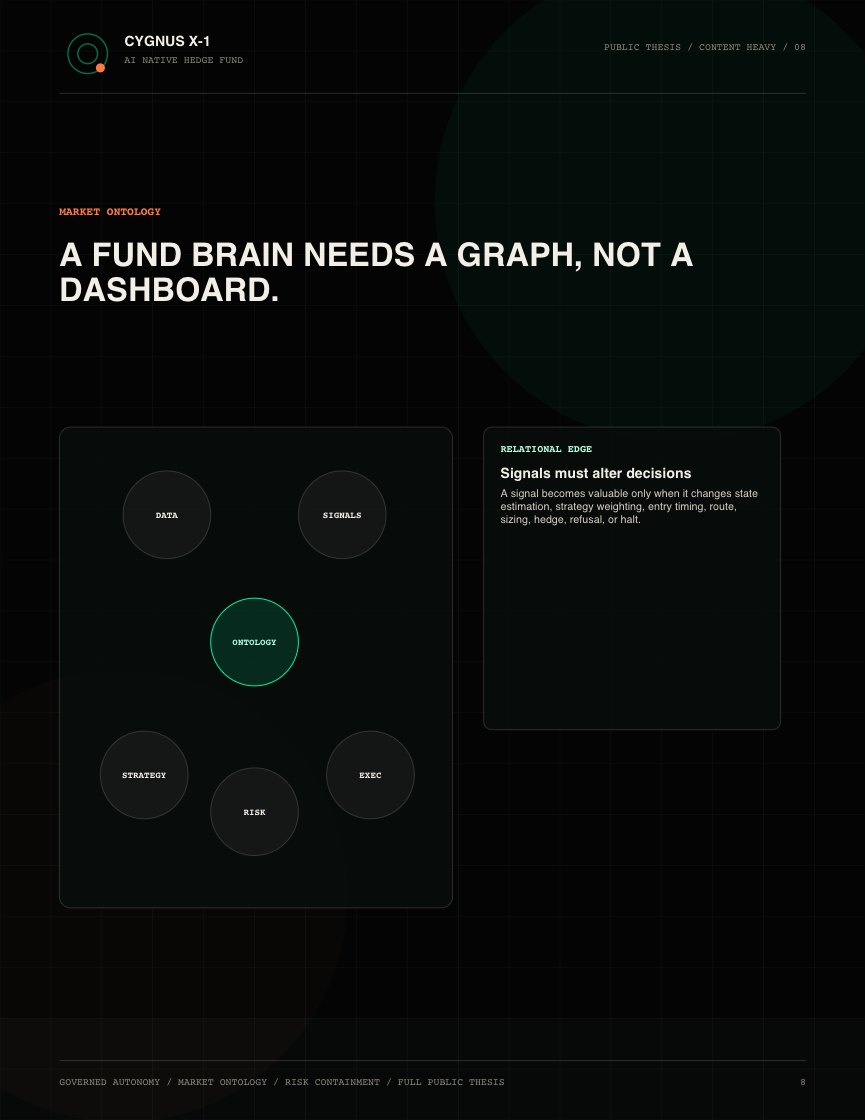
Ontology plus specialized agents creates a traceable capital system. The system understands assets, venues, wallets, signals, limits, routes, and outcomes as connected state objects.
Moat formation
The durable asset is not one signal. It is the labeled memory produced by every trade, rejected trade, failed thesis, slippage event, hedge, and model revision.
Market structure shift
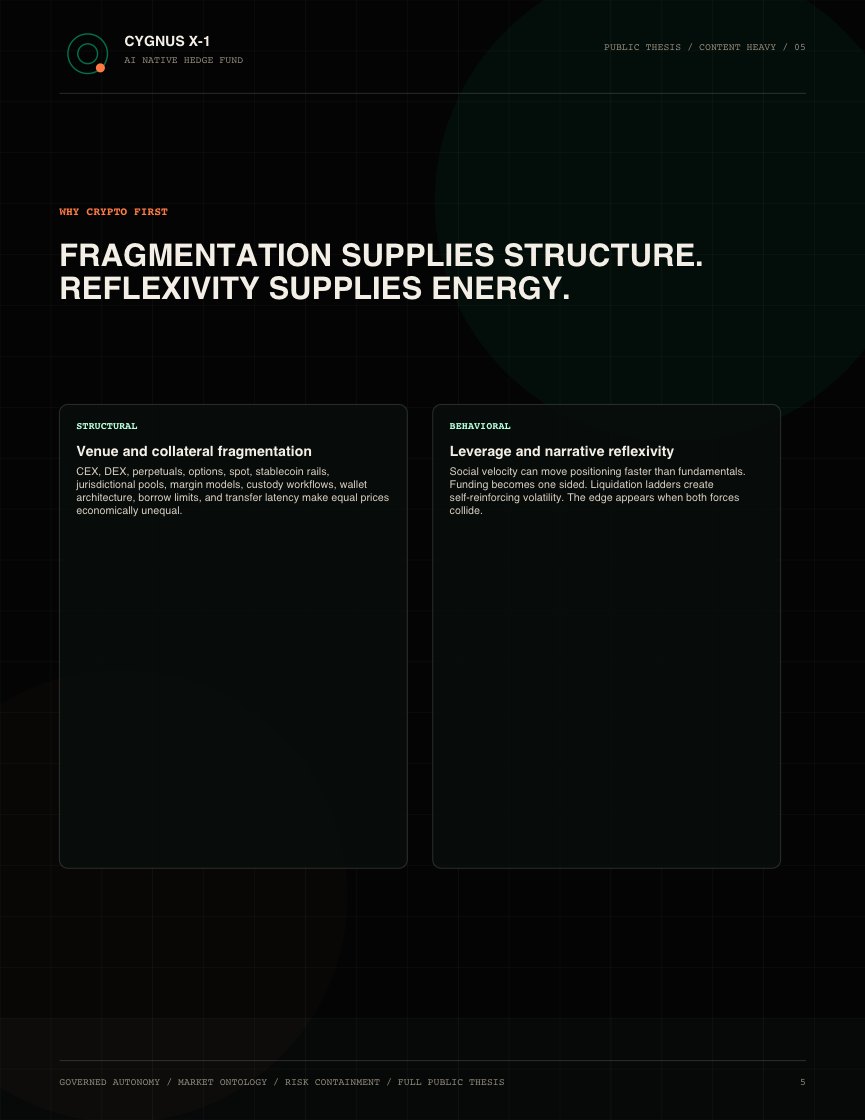
Crypto is the first proving ground because fragmentation is structural, not accidental.
Cygnus X-1 is multi asset in direction, but crypto concentrates the initial conditions that matter: venue fragmentation, collateral silos, perpetual funding, on chain and off chain discontinuities, liquidation reflexivity, social velocity, and round the clock execution risk.
Equal prices do not imply equal opportunity.
Route quality, margin model, custody workflow, gas cost, borrow availability, settlement path, venue rules, and counterparty risk can make the same nominal spread economically different.
Reflexivity supplies the energy.
Funding imbalance, liquidation ladders, narrative contagion, leverage, crowding, and forced unwinds create temporary states that machine systems can detect before committees can metabolize them.
The bottleneck has moved.
The limiting factor is less raw data access and more hypothesis bandwidth, cross signal synthesis, regime interpretation, and disciplined refusal under uncertainty.
Governed autonomy architecture
Autonomy is delegated authority inside a control perimeter.
The system is designed as a capital operating graph. Agents do not receive unlimited discretion. They operate under defined mandates, permission boundaries, risk constraints, model registries, escalation rules, and audit requirements.
Capital
Graph
Graph
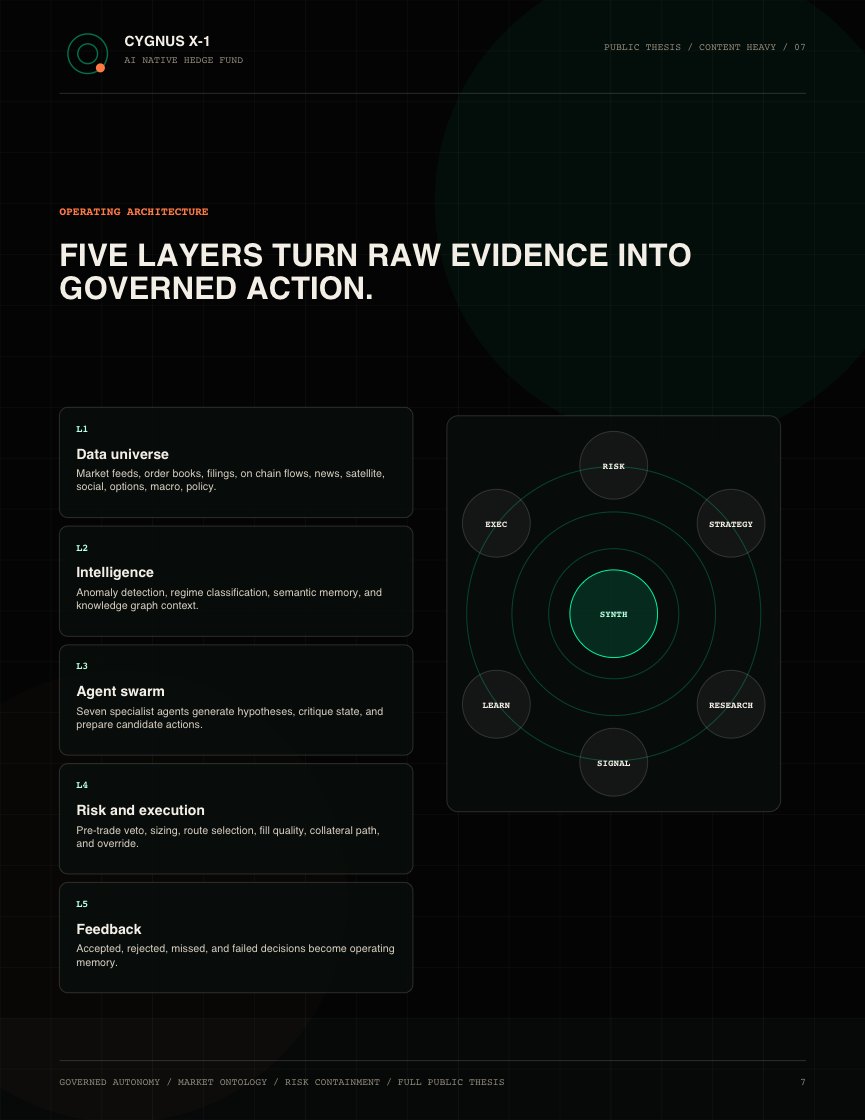
DataOrder books, filings, on-chain flows, macro, social velocity, derivatives.
SignalsFunding divergence, liquidation density, volatility, narrative, regime state.
StrategiesCarry, stat arb, volatility, event driven, DeFi, cross asset macro.
RiskExposure, drawdown, liquidity, drift, custody, concentration, policy.
ExecutionRoute, size, hedge, reject, unwind, collateral, cost model.
AuditModel version, rationale, exception, fill, outcome, attribution.
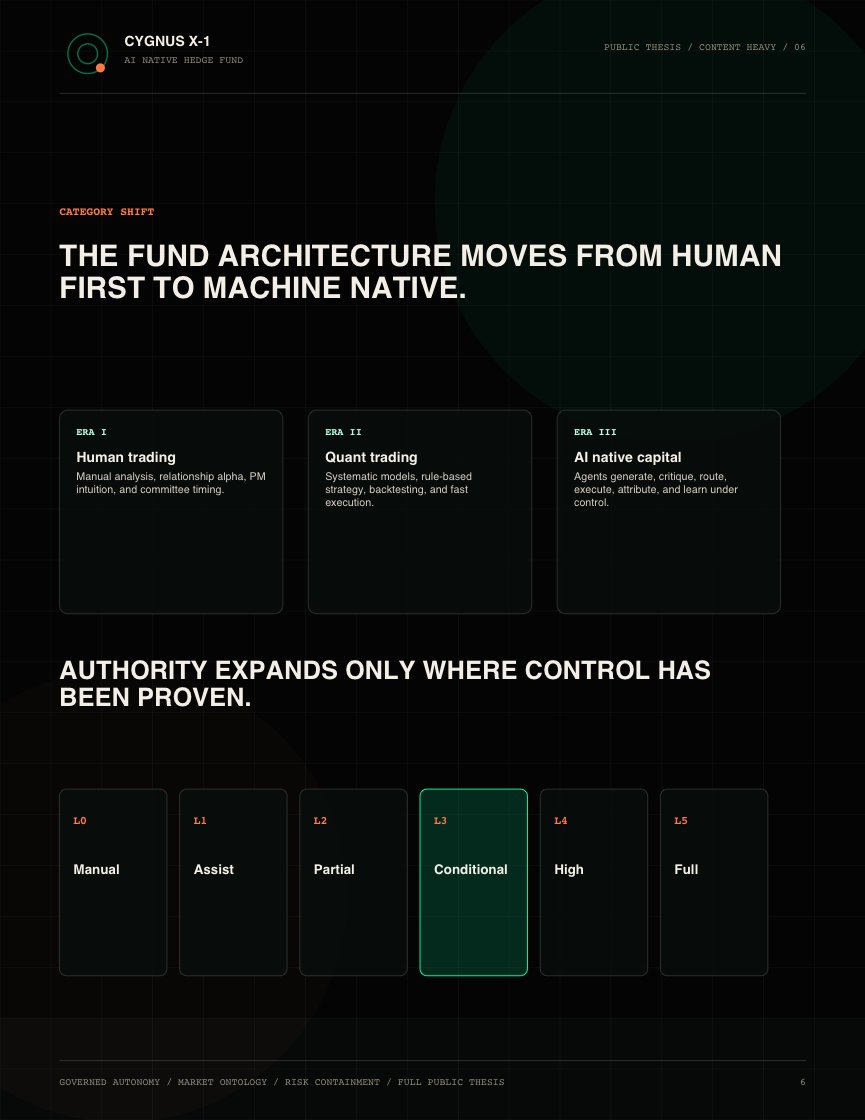
L1 Signal intelligence
AI surfaces structured signals for human review: filings, order books, on chain flows, macro state, and narrative velocity.
L2 Assisted strategy
Agents propose hypotheses, estimate cost, prepare backtests, and document falsification conditions for human approval.
L3 Conditional autonomy
Agents run bounded research to execution loops inside predefined strategy, exposure, venue, and drawdown constraints.
L4 High autonomy
The system handles most routine scenarios while escalating exceptions, drift, abnormal execution, and policy conflicts.
L5 Full autonomy target
The long term target is governed autonomous finance with continuous learning, traceability, auditability, and explicit regulatory perimeter.
Bounded authority
Machine discretion expands only inside explicit limits. Permissions are earned through evidence, not granted through ambition.
Independent risk function
The RISK agent is not a dashboard. It is an active control layer with veto power over candidate actions.
Traceable state changes
Every action requires a chain of custody: source signal, thesis, model version, risk decision, route, fill, and outcome.
Agent operating system
Seven operating roles, not seven characters.
The agent system is framed as governed delegation across the fund loop. Each role has a defined contribution, boundary, and failure mode. The value is coordination under audit, not the appearance of intelligence.
Detect state change.
Identifies anomalies, flow shifts, funding divergence, volatility state, liquidation density, and cross-signal collisions.
Establish context.
Interprets filings, policy, market structure, historical analogues, source credibility, and regime conditions.
Generate candidate policy.
Builds strategy candidates with causal mechanism, expected net edge, falsification condition, and promotion requirements.
Constrain and veto.
Reviews exposure, liquidity, venue concentration, drawdown, model drift, policy perimeter, and exception triggers.
Route and protect implementation.
Estimates slippage, venue quality, fill probability, collateral path, hedge quality, and unwind safety.
Attribute outcomes.
Transforms accepted, rejected, missed, and failed actions into structured memory and model improvement signals.
Resolve fund action.
Reconciles local agent outputs into a portfolio decision with rationale, risk state, escalation status, and audit record.
Execution and control stack
The first duty of the machine is refusal.
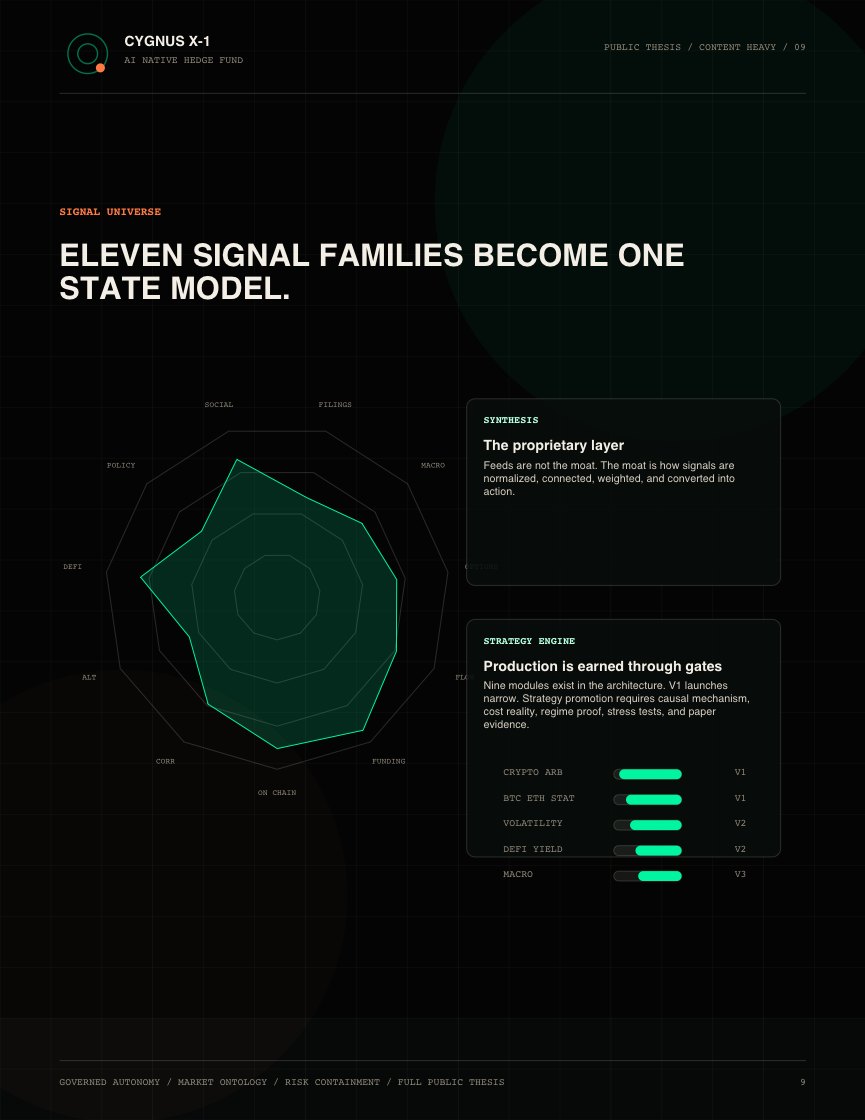
Cygnus X-1 is ambitious in final architecture and conservative in initial deployment. The V1 surface is intentionally narrow: prove execution quality, risk containment, and learning discipline before expanding the strategy universe. Simulation only. No live orders.
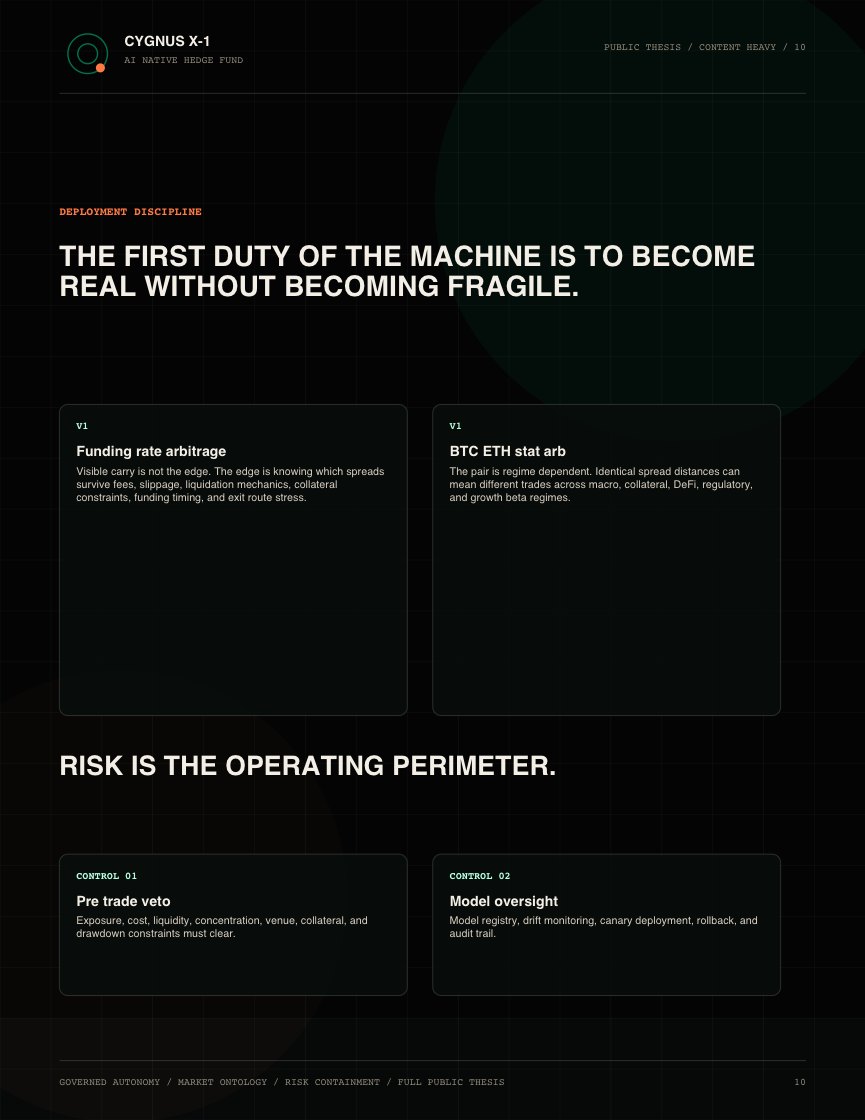
Visible carry is not the edge.
The edge is knowing which spreads survive fees, slippage, liquidation mechanics, collateral constraints, funding timing, and exit route stress.
The pair is regime dependent.
BTC and ETH change roles across macro, collateral, DeFi, and growth beta regimes. Identical spread distances can mean different trades.
Leverage creates state transitions.
Options, perpetuals, liquidation maps, dealer behavior, and crowding can identify volatility that is underpriced, overpaid, or mislocated.
Yield is reviewed through risk first.
Protocol exposure, smart-contract surface, stablecoin rails, slippage, and reward durability are normalized before capital is routed.
Shared state connects markets.
Crypto, equities, rates, FX, commodities, policy, and liquidity regimes become comparable through a common market ontology.
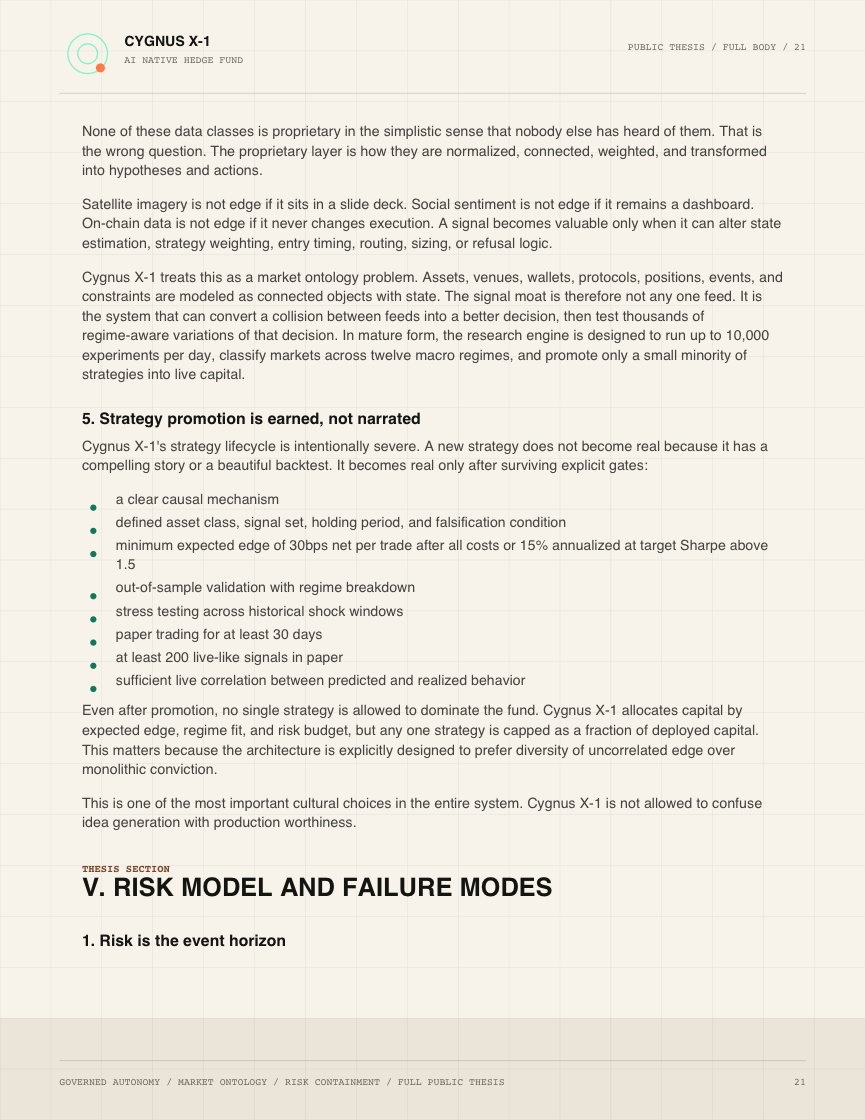
Production is earned.
Mechanism, net edge, out of sample validation, stress history, paper signal volume, and risk approval precede live deployment.
Gate 01
Causal mechanism and falsification
Strategy committee inputThe system must know why a strategy should work and what evidence should kill it.
Gate 02
Net edge after all costs
Execution reviewGross signal is not enough. Fees, slippage, borrow, transfer, gas, latency, and unwind cost are part of the test.
Gate 03
Regime and stress validation
Risk reviewBacktests are segmented by regime and reviewed against historical shock windows and liquidity stress.
Gate 04
Paper promotion window
Launch disciplineLive-like signals must show sufficient volume, correlation, exception behavior, and reporting integrity before promotion.
Risk containment and oversight
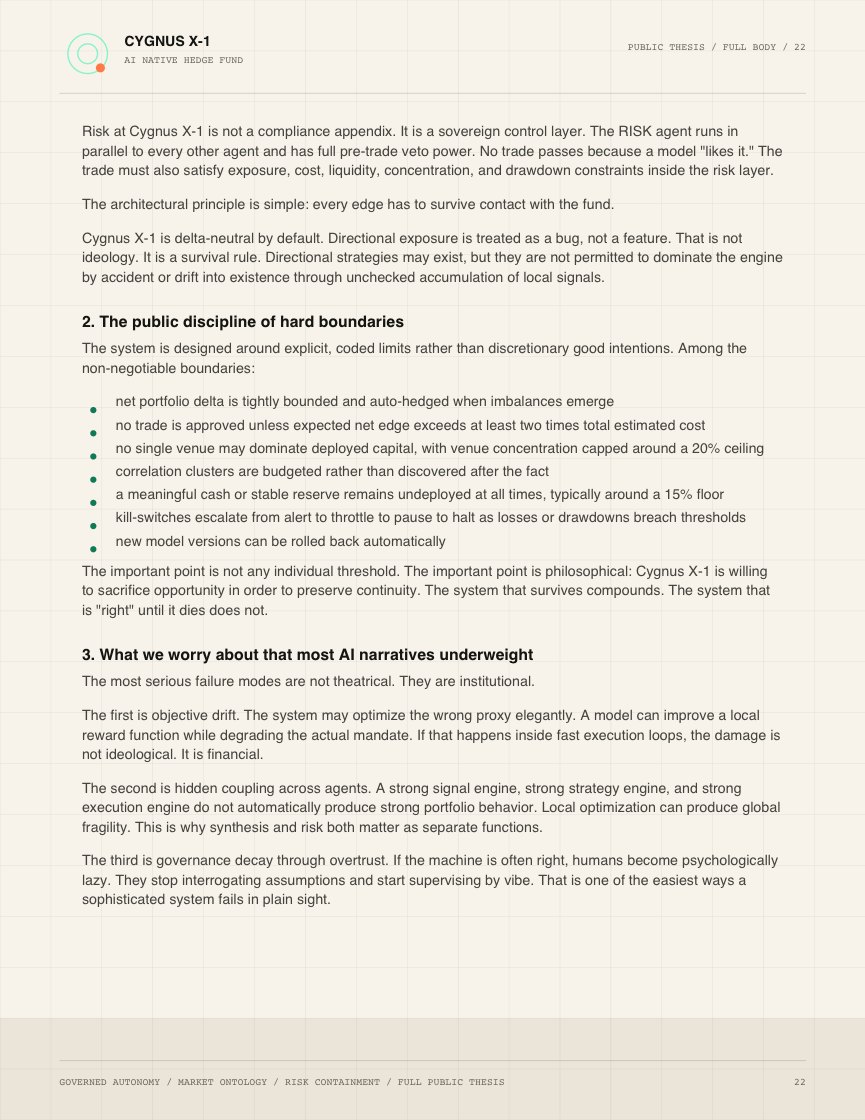
Risk veto is not a feature. It is the operating perimeter.
Serious investors do not underwrite autonomy unless they understand how it is constrained. Cygnus X-1 frames risk as a sovereign control surface: limits, vetoes, escalation paths, model monitoring, auditability, and human override at launch.
Exposure limits
Venue controls
Drawdown boundary
Human override
Pre trade veto
No candidate action passes because a model is confident. It must satisfy exposure, cost, liquidity, concentration, venue, collateral, and drawdown rules.
Policy perimeter
Strategy, instrument, venue, custody, counterparty, leverage, and jurisdiction constraints define what the machine is allowed to touch.
Model oversight
Model registries, drift monitoring, symbolic validation, canary deployments, and versioned rationale reduce the risk of fluent but misaligned action.
Exception handling
Drawdown, abnormal fills, venue outage, liquidity break, model drift, and policy conflict escalate from alert to throttle to pause to halt.
Humans govern objectives, permissions, and failure boundaries.
L3 launch means humans remain available for edge cases, restarts, override, reporting review, and capital permissioning. Higher autonomy is evidence-gated.
Every action needs chain of custody.
Signal, thesis, backtest, model version, risk decision, route, fill, exception, and outcome must remain available for internal review and investor diligence.
Strategic asymmetry
The moat is the operating memory that survives contact with markets.
The strategic bet is that the early leader with the best live dataset, execution memory, risk discipline, and institutional credibility becomes disproportionately difficult to catch. The fund is the proving ground; the platform is the scaling mechanism only after proof.
Each action becomes labeled evidence.
Signals, accepted trades, rejected trades, fills, slippage, hedges, misses, and failures become proprietary training material.
Market topology becomes operational memory.
Rules, fees, liquidity, collateral paths, outages, and stress behavior become part of a continuously updated execution map.
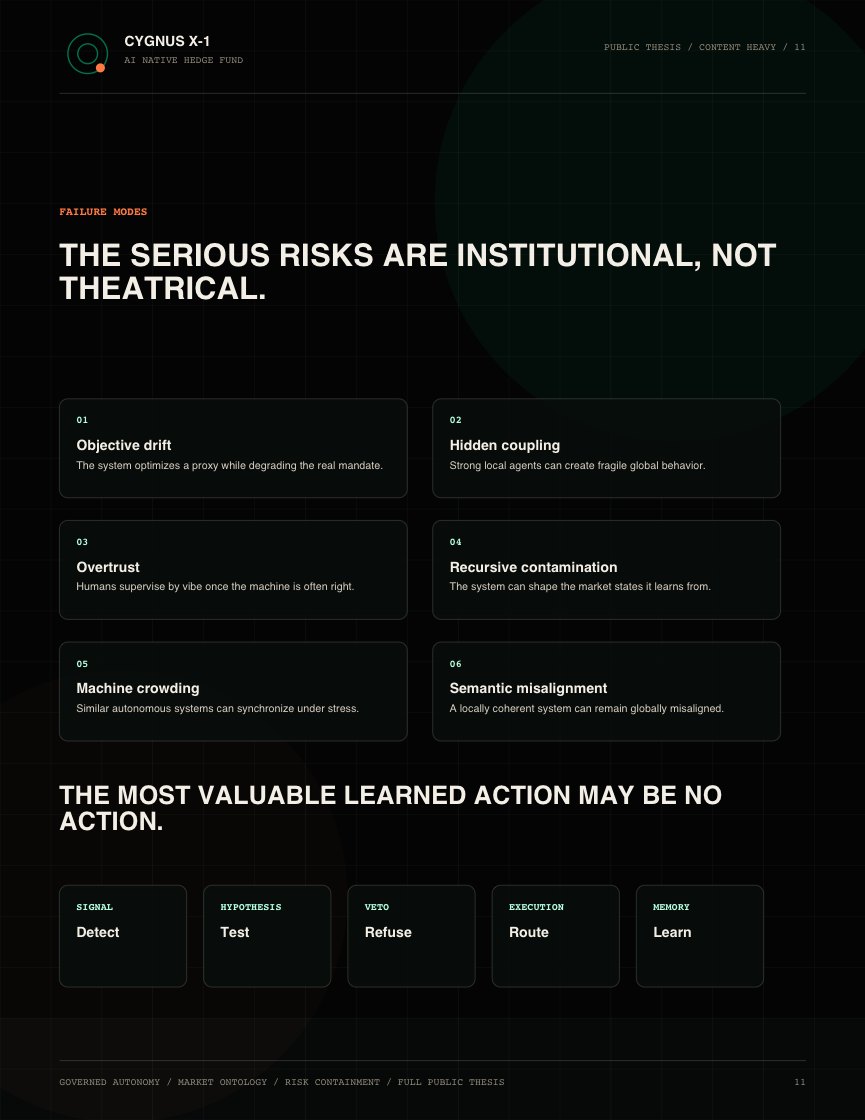
The most valuable learned action may be no action.
A mature system should improve not only entries and sizing, but the discipline to ignore familiar patterns under the wrong regime.
Deployment sequence
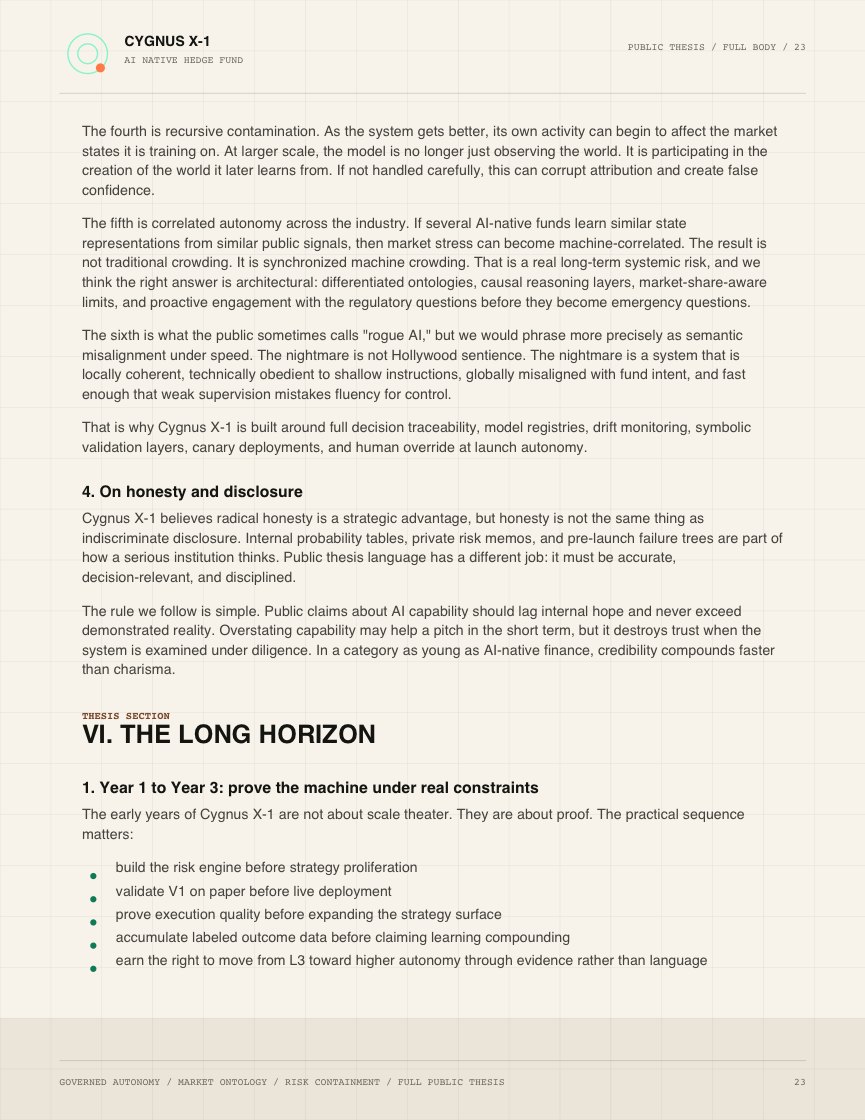
Credibility compounds through restraint.
The roadmap is designed to keep public claims behind demonstrated capability. Controls and reporting are built before strategy proliferation. Higher autonomy is earned through validation rather than language.
Proof build
Build V1 architecture, run live simulations, validate risk gates, and define reporting discipline before outside capital review.
Controlled launch path
Move toward L3 autonomy under human override, expand venue coverage, and accumulate labeled operating memory.
Strategy expansion
Add volatility, DeFi, event, and macro modules only after V1 survives live-like execution and risk constraints.
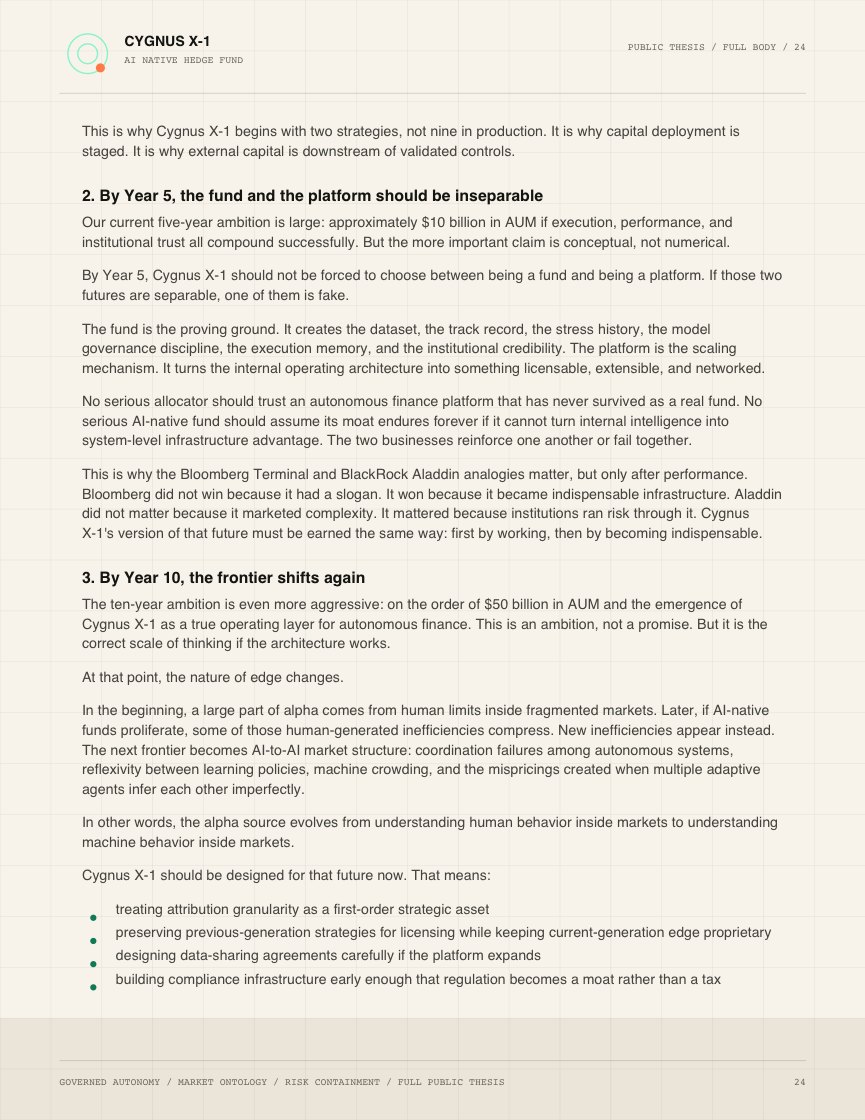
Fund to platform trajectory
Convert internal architecture into autonomous research, risk intelligence, execution orchestration, and fund infrastructure once the fund earns institutional trust.
Diligence mode
A controlled review process, not a client side security claim.
The diligence layer is organized like an investor data room: clear review lanes, version discipline, public versus gated separation, and a practical sequence for evaluating thesis, controls, operating readiness, and fit.
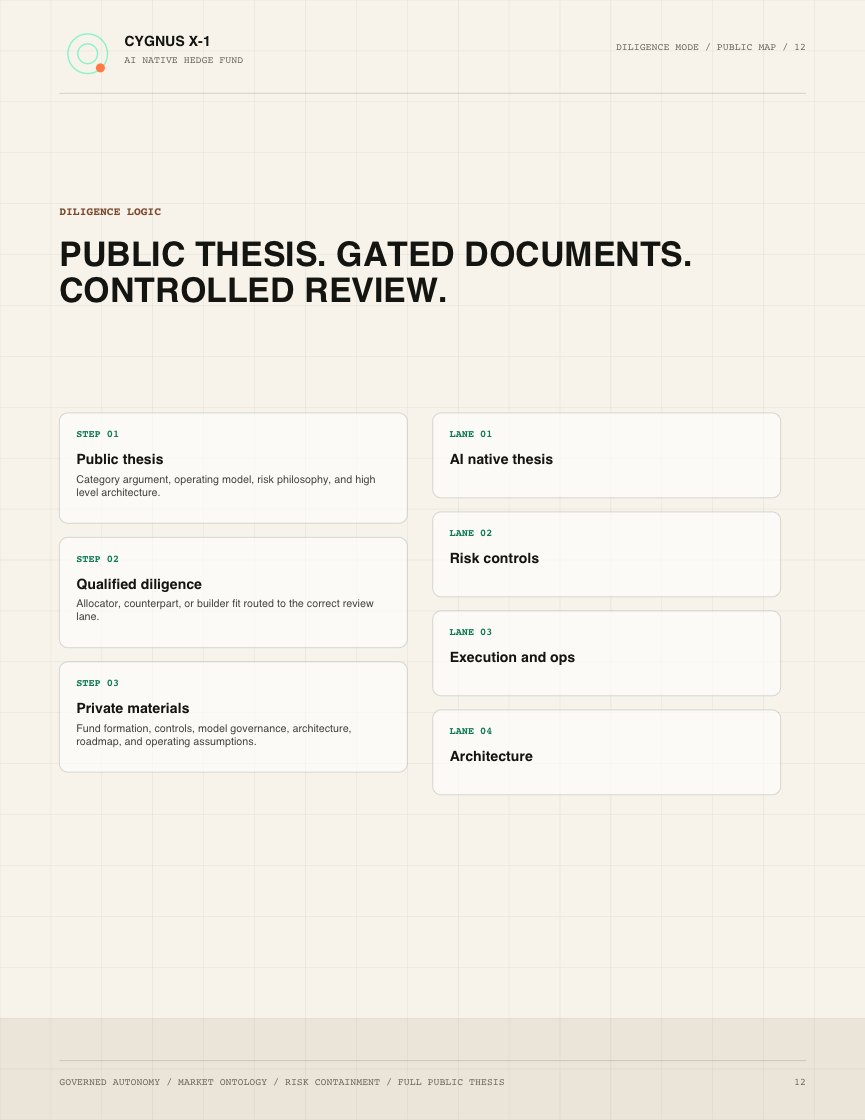
Step 01
Public thesis review
PublicEvaluate worldview, market structure rationale, AI native definition, and risk philosophy.
Step 02
Qualified diligence request
Gated requestIdentify allocator, counterpart, or builder fit and route the conversation to the correct review lane.
Step 03
Private materials review
Gated reviewReview fund formation, controls, model governance, architecture, roadmap, and operating assumptions.
Lane 01
Thesis and category
Public thesisWhy AI native architecture matters; why crypto first; what edge is expected to compound.
Lane 02
Risk and governance
Gated reviewLimits, veto authority, override policy, escalation logic, model oversight, and auditability.
Lane 03
Execution and operations
Gated reviewVenue connectivity, cost model, collateral path, reporting, custody posture, and operating readiness.
Lane 04
Strategic participation
Gated reviewInvestor fit, infrastructure counterparties, senior builders, and fund to platform implications.
Public thesis
Open review document embedded in the site.
The public thesis is the first diligence layer. It is available directly here for allocator first pass review, with a separate download path for offline reading. The thesis is public; operating documents remain gated for qualified diligence.
- ScopeWorldview, market structure rationale, AI native fund architecture, risk philosophy, and long horizon operating model.
- StatusPublic review document. It does not expose private operating materials, fund formation documents, or gated control specifications.
- ActionRead here, open the dedicated route, download the PDF, then initiate qualified review if the operating model is relevant to mandate.
Public
01
AI native investment thesis
Worldview, market inefficiency thesis, autonomy model, and long term fund to platform direction.
Intended to support the first pass: does the operating model deserve a private review?
Materials logic
Public thesis. Gated operating documents. No public-hosting overclaim.
The public site communicates the structure of diligence without implying that confidential materials live here. Cygnus X-1 keeps the thesis public and routes fund formation, controls, model governance, architecture, roadmap, and operating assumptions into qualified review.
Decision relevant thesis
Category argument, operating model, risk philosophy, and high level architecture.
Operating review
Controls, formation detail, roadmap, model governance, materials, and operating documents.
Public thesis is open. Operating documents remain gated for qualified review.
Access flow
Qualified diligence begins inside Cygnus OS.
The access path is intentionally specific. Cygnus X-1 is seeking serious allocator review, strategic counterpart discussions, and senior builders who understand fund operations, market structure, risk, and autonomous systems.
Initiate allocator review.
For institutional LPs, family offices, and crypto-native allocators evaluating stage, controls, reporting, formation path, risk governance, and the evidence required before capital deployment.
Founder context
Built against market structure, not presentation culture.
Nikhil Sharma
Founder, Cygnus X-1
Nikhil Sharma is a crypto markets operator and builder of Hillnick Capital, a decentralized crypto hedge fund. The relevant founder signal is not personal branding; it is proximity to fund operations, DeFi strategy, digital-asset market structure, institutional relationships, and the practical gap between AI demos and capital systems that can be governed under risk.
The company is being built against a specific problem: most AI-in-finance narratives stop at research acceleration, while the harder institutional problem is controlled delegation across signal, strategy, risk, execution, and learning.
Private review
If this operating model is relevant to your mandate, initiate review.
The claim is deliberately narrow: a governed autonomous capital system may be able to infer more market state, test more policy surfaces, reject more fragile action, and compound operating memory faster than a human-centered fund architecture. The next step is not hype. It is diligence.
This website is informational only and does not constitute an offer to sell securities, a solicitation to buy, investment advice, legal advice, tax advice, or a recommendation of any security, digital asset, fund interest, or investment strategy. Any future offering would be made solely through definitive offering documents and only to eligible, qualified, accredited, professional, or otherwise permitted investors in applicable jurisdictions.
Digital assets and private funds involve substantial risk, including loss of capital, illiquidity, technology risk, regulatory risk, volatility, custody risk, model risk, and operational risk. Past, simulated, backtested, or paper performance does not guarantee future results. No real trading or live order execution is available from this public review surface. Final legal, regulatory, tax, and investment analysis requires qualified professional advisers.